 On July 9, members of the Baha’i Faith commemorate the anniversary of the Martyrdom of the Bab (“the gate” in Arabic), one of nine holy days on which members of the Baha’i Faith suspend work and school.
The Báb referred to this coming Divine Teacher as “Him Whom God shall make manifest” and stated that “no words of Mine can adequately describe Him, nor can any reference in My Book, the Bayan, do justice to His Cause.” He clarified the central aim of His mission by explaining that “the purpose underlying this Revelation, as well as those that preceded it, has, in like manner, been to announce the advent of the Faith of Him Whom God will make manifest.” The basis for all human accomplishment is to be found in the teachings of this promised universal Manifestation of God, and “the sum total of the religion of God is but to help Him.” For the Báb, a climacteric in human history had been reached, and He was the “Voice of the Crier, calling aloud in the wilderness of the Bayan” announcing to humanity that it was entering the period of its collective maturity.
Throughout His writings, the Báb warned His followers to be watchful, and as soon as the promised Teacher revealed Himself, to recognize and follow Him. The Báb exhorted them to see with the “eye of the spirit” rather than through their “fanciful imaginations.” To be worthy of “Him Whom God shall make manifest” required entirely new standards of conduct, a nobility of character that human beings had theretofore not achieved: “Purge your hearts of worldly desires,” the Báb urged His first group of disciples, “and let angelic virtues be your adorning...The time is come when naught but the purest motive, supported by deeds of stainless purity, can ascend to the throne of the Most High and be acceptable unto Him...”
The boldness of the Báb’s proclamation—which put forth the vision of an entirely new society—stirred intense fear within the religious and secular establishments. Accordingly, persecution of the Bábis quickly developed. Thousands of the Báb’s followers were put to death in a horrific series of massacres. The extraordinary moral courage evinced by the Bábis in the face of this onslaught was recorded by a number of Western observers. European intellectuals such as Ernest Renan, Leo Tolstoy, Sarah Bernhardt and the Comte de Gobineau were deeply affected by this spiritual drama that had unfolded in what was regarded as a darkened land. The nobility of the Báb’s life and teachings and the heroism of His followers became a frequent topic of conversation in the salons of Europe. The story of Tahirih, the great poet and Bábi heroine, who declared to her persecutors, “You can kill me as soon as you like, but you cannot stop the emancipation of women,” traveled as far and as quickly as that of the Báb Himself.
Ultimately, those opposed to the Báb argued that He was not only a heretic, but a dangerous rebel. The authorities decided to have Him executed. On 9 July 1850, this sentence was carried out, in the courtyard of the Tabriz army barracks. Some 10,000 people crowded the rooftops of the barracks and houses that overlooked the square. The Báb and a young follower were suspended by two ropes against a wall. A regiment of 750 Armenian soldiers, arranged in three files of 250 each, opened fire in three successive volleys. So dense was the smoke raised by the gunpowder and dust that the entire yard was obscured.
The report of the execution, written to Lord Palmerston, the British Secretary of State for Foreign Affairs, by Sir Justin Shiel, Queen Victoria’s Envoy Extraordinary and Minister Plenipotentiary in Tehran on July 22, 1850, records: “When the smoke and dust cleared away after the volley, Báb was not to be seen, and the populace proclaimed that he had ascended to the skies. The balls had broken the ropes by which he was bound but he was dragged from the recess where, after some search he was discovered and shot.”
After the first attempt at execution, the Báb was found back in His cell, giving final instructions to one of His followers. Earlier in the day, when the guards had come to take Him to the courtyard, the Báb had warned that no “earthly power” could silence Him until He had finished all that He had to say. When the guards arrived this second time, the Báb calmly announced: “Now you may proceed to fulfill your intention.”
Again, the Báb and His young companion were brought out for execution. The Armenian troops refused to fire, and a Muslim firing squad was assembled and ordered to shoot. This time the bodies of the pair were shattered, their bones and flesh mingled into one mass. Surprisingly, their faces were untouched. The light of the “Mystic Fane,” as the Báb referred to Himself, had been quenched under a dramatic set of circumstances.The last words of the Báb to the crowd were: “O wayward generation! Had you believed in Me every one of you would have followed the example of this youth, who stood in rank above most of you, and would have willingly sacrificed himself in My path. The day will come when you will have recognized Me; that day I shall have ceased to be with you.”
Showing posts with label Religion. Show all posts
Showing posts with label Religion. Show all posts
Wednesday, July 8, 2009
The Báb, Forerunner of Bahá’u’lláh


Tuesday, June 3, 2008
Baha’i Election
Though the season of primaries is almost behind us, November is nearly half a year away and we could still be in for a lot more partisan politics and mudslinging. If it seems like there ought to be a more civil way to run democratic elections, members of the Baha’i faith say that’s because there is. And once a year, they refine a new democratic process in that big white temple in north suburban Wilmette. The 100th Baha’i National Convention was recently held there. Eight Forty-Eight contributor Jennifer Brandel watched the process.
Listen to the full story here:
http://chicagopublicradio.org/Content.aspx?audioID=24887
النظام الاداري البهائي
أنزل حضرة بهاء الله النظام الإداري الخاص به ، أي أنه أخبرنا عن المؤسسات البهائية التي يجب أن تعمل وتدير شئون العالم الإنساني
فلا وجود لرجال دين فى الدين البهائي بل مؤسسات بهائية هى نواة لما سيصبح فى المستقبل النظام العالمي
فلا وجود لرجال دين فى الدين البهائي بل مؤسسات بهائية هى نواة لما سيصبح فى المستقبل النظام العالمي
المؤسسات البهائية هي
بيت العدل الأعظم: وهو المؤسسة العليا فى الدين البهائي والذي يتوجه له جميع البهائيون في العالم. ويتم انتخابه كل خمس سنوات من قبل اعضاء المحافل المركزية فى العالم كله ، حيث يحق لهم انتخاب تسعة افراد بهائيين بالغين (من سن 21 سنة) من اى منطقة فى العالم.
المحفل الروحاني المركزي: ينتخب البهائيون في كل دولة أعضاؤه التسعة مرة في كل سنة، وهو المسئول عن الجامعة البهائية فى الدولة
المحفل الروحاني المحلي: هو الذي يقود شؤون الجامعة البهائية بالمدينة ويتم انتخاب أعضاؤه التسعة من قبل أعضاء الجامعة المحلية
جميع المؤسسات البهائية يتم انتخاب اعضاءها عن طريق الاقتراع السري فلا يسمح بالترشيحات او الدعاية. كما لايتلقى اعضاء المؤسسة اى اجر على مايقومون به من خدمات فهم يفعلون ذلك لوجه الله تعالى. من ناحية اخرى الانتخاب هو واجب مقدس على كل فرد بهائي ،لذلك يقوم كل فرد بالبحث والتحري بنفسه عن الاصلح لهذا النوع من الخدمة، كما يطلب التأييد والتوفيق من الله سبحانه وتعالى.
Thursday, May 29, 2008
The Ascension of Baha'u'llah
Holy day marks 116th anniversary of the passing of Baha’u’llah
 Around the globe, tens of thousands more turned their faces in the direction of the same shrine – for Baha’is, the holiest spot on earth – in remembrance of the night in 28 May, 1892 that Baha’u’llah passed away at His home near Acre in the Holy Land.
His remains were entombed on the same property, now a site of pilgrimage for members of the Baha’i Faith the world over.
Baha’u’llah was born in Tehran, Iran, but He and a large group of His followers were banished from their native land in 1853 and forced to go first to Baghdad, then on to what was the Ottoman Empire and the remote prison city of Acre.
Baha’is believe that Baha’u’llah is the Messenger of God for this age, the most recent in a line of divine educators that includes Buddha, Jesus, Krishna, Mohammed, Moses, and Zoroaster, among others.
The anniversary of the Ascension of Baha’u’llah is one of nine holy days on which Baha’is suspend work.
Prayer

The praise which hath dawned from Thy most august Self, and the glory which hath shone forth from Thy most effulgent Beauty, rest upon Thee, O Thou Who art the Manifestation of Grandeur, and the King of Eternity, and the Lord of all who are in heaven and on earth! I testify that through Thee the sovereignty of God and His dominion, and the majesty of God and His grandeur, were revealed, and the Daystars of ancient splendor have shed their radiance in the heaven of Thine irrevocable decree, and the Beauty of the Unseen hath shone forth above the horizon of creation. I testify, moreover, that with but a movement of Thy Pen Thine injunction “Be Thou” hath been enforced, and God’s hidden Secret hath been divulged, and all created things 231 have been called into being, and all the Revelations have been sent down.
Bahá’u’lláh
Monday, May 5, 2008
House of Worship restoration necessitates partial closing

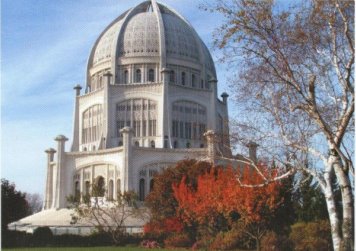
To enable further restoration of the Baha'i House of Worship and begin construction of the new Visitors Center, the lower level of the House of Worship, which currently houses the Visitors Center and bookstore, will be closed to the public for approximately one year, from May 19, 2008, to May 2009.
The auditorium (prayer hall), on the upper level of the House of Worship, will remain open for prayers and meditation. The elevator to the auditorium will not be available so access to the auditorium will be by stairs only during this period. The gardens are wheelchair accessible.
Guides will continue to offer tours of the temple, and restrooms will be available. During the partial closing, visitors will enter the temple from the corner of Linden Avenue and Sheridan Road, walking along the reflecting pool before ascending the stairs to the auditorium.
There will be a limited number of spaces in the House of Worship parking lot to the west of the building. Parking on nearby streets also will be available.
Saturday, May 3, 2008
Prayer for the Mashriqu'l Adhkar

"O Lord, O Thou Who dost bless all those who stand firm in the Covenant by enabling them, out of their love for the Light of the World, to expend what they have as an offering to the Mashriqu'l Adhar, the dayspring of Thy wide-spread rays and the proclaimer of Thine evidences, help Thou, both in this world and the world to come, these reghteous, these upright and pious ones to draw ever nearer to Thy sacred Threshold, and make bright their faces with Thy dazzling splendors.
Verily art Thou the Generous, the Ever-Bestowing."
Abdu'l Baha
Thursday, May 1, 2008
The Ridwan Festival

In April 1863, before leaving Baghdad, Bahá'u'lláh and His companions camped in a garden on the banks of the Tigris River. From 21 April to 2 May, Bahá'u'lláh shared with those Bábis in His company that He was the Promised One foretold by the Báb--foretold, indeed, in all the world's scriptures.
The garden became known as the Garden of Ridwan, which indicates "paradise" in Arabic. The anniversary of the twelve days spent there are celebrated in the Bahá'í world as the most joyous of holidays, known as the Ridwan Festival.
On 3 May 1863, Bahá'u'lláh rode out of Baghdad, on His way to Constantinople, the imperial capital, accompanied by His family and selected companions. He had become an immensely popular and cherished figure. Eyewitnesses described the departure in moving terms, noting the tears of many scholars, government officials and onlookers and the honor paid to Him by the authorities. After four months in Constantinople, Bahá'u'lláh was sent as a virtual state prisoner to Adrianople (modern Edirne), arriving there on 2 December 1863. During the five years He spent there, Bahá'u'lláh's reputation continued to grow, attracting the intense interest of scholars, government officials and diplomats.
He refers to His Declaration as “the Day of supreme felicity” and He describes the Garden of Ridwán as “the Spot from which He shed upon the whole of creation the splendours of His Name, the All-Merciful”.
The Declaration of Bahá’u’lláh is celebrated annually by the twelve-day Ridwán Festival, described by Shoghi Effendi as “the holiest and most significant of all Bahá’í festivals”
Baha'u'llah called Ridwan the Most Great Festival and the King of Festivals. He said:
"Call ye to mind, O people, the bounty which God hath conferred upon you. Ye were sunk in slumber, and lo! He aroused you by the reviving breezes of His Revelation, and made known unto you His manifest and undeviating Path"
Sunday, February 17, 2008
The Fundamental of Spiritual Education
Education is of three kinds: material, human and spiritual.
Material education is concerned with the development of the body.
Human education is about civilization and progress. It deals with government, administration, charitable works, trades, arts, and handicrafts, sciences, great inventions and discoveries.
Spiritual education consists in acquiring divine perfections. This is true education, for by its aid the spiritual, the higher nature of the human being is developed.

In order to progress, humanity needs an educator who has clear authority as a material, human and spiritual educator.
Humanity has always been in need of such a perfect educator, one who can help it organize matters related to the nourishment and health of the body, inspire it to advance in knowledge, invention and discovery, and, most importantly, breathe into it the real life of the spirit. No ordinary human being can achieve these formidable tasks. Only the Manifestations of God have the power to accomplish them. These are chosen souls who are sent by God from time to time to be the Universal Educators of humanity.
“All men have been created to carry forward an ever-advancing civilization”
“The Purpose of the one true God, exalted be His glory, in revealing Himself unto men is to lay bare those gems that lie hidden within the mine of their true and inmost selves.”
“God’s purpose in sending His Prophets unto men is twofold. The first is to liberate the children of men from the darkness of ignorance, and guide them to the light of true understanding. The second is to ensure the peace and tranquility of mankind, and provide all the means by which they can be established.”
“Men at all times and under all conditions stand in need of one to exhort them, guide them and to instruct and teach them.”
From the Writings of Baha’u’llah
Station of Abdu’l-Baha:
Abdu’l-Baha is a most unique Figure in human history, and no previous religion has been blessed with such a Personage. Not only did Baha’u’llah give humanity His most sublime Revelation, but He also gave it His own Son.
“My name is Abdu’l-Baha. My qualification is Abdu’l-Baha. My reality is Abdu’l-Baha. My Praise is Abdu’l-Baha. Thralldom to the Blessed Perfection is my glorious and refulgent diadem, and servitude to all the human race my perpetual religion…No name, no title, no mention, no commendation have I, nor will ever have, except Abdu’l-Baha. This is my longing. This is my greatest yearning. This is my eternal life. This is my everlasting glory.”
What is the Baha’I Faith?
The Baha’I Faith is a world religion whose purpose is to unite all the races and peoples in one universal Cause and one common Faith. Baha’u’llah is the Promised One of all Ages. The Manifestations of God are like perfect mirrors that reflect the Light of God in all its Splendor. While God is beyond our reach, these perfect Beings come to us from time to time, live among us, give us guidance, and fill us with the energy we need to progress, materially and spiritually.
“That which the Lord hath ordained as the sovereign remedy and mightiest instrument for the healing of all the world is the union of all its peoples in one universal Cause, one common Faith.”
What is the reason behind our creation?
“O Son of Man! I loved thy creation, hence I created thee. Wherefore, do thou love Me, that I may name they name and fill the soul with the spirit of life.” The Hidden Words, Arabic
“The Immortality of the spirit is the fundamental basis of Divine Religions.”
‘Abdu’l Baha
Baha’is believe in one loving Creator who created us all in order to know and love Him. Baha’is believe that all the peoples of the world belong to one human family. The differences in color, backgrounds, traditions, thoughts and ideas should enhance our experience like a garden with flowers of every form, color and appearance.
Baha’is believe that all the religions teach the same truth. The only difference between them is that each have appeared in a different time in the history of humanity in order to help people to be educated according to the needs of that time. Baha’u’llah’s teachings address the needs and conditions of the world today.
The Soul – A sign of God
“Know, verily, that the soul is a sign of God, a heavenly gem whose reality the most learned of men hath failed to grasp, and whose mystery no mind, however acute, can ever hope to unravel. It is the first among all created things to declare the excellence of its Creator, the first to recognize His glory, to cleave to His truth, and to bow down in adoration before Him. If it be faithful to God, it will reflect His light, and will, eventually, return unto Him. If it fail, however, in its allegiance to its Creator, it will become a victim to self passion, and will, in the end, sink in their depths.”
Baha’u’llah
The Mind, Spirit and Soul
“The human spirit which distinguishes man from the animal is the rational soul, and these two names designate one thing. ……The human spirit, unless assisted by the spirit of faith, does not become acquainted with the divine secrets and the heavenly realities. It is like a mirror which, although clear, polished and brilliant, is still in need of light. Until a ray of the sun reflects upon it, it cannot discover the heavenly secrets.
But the mind is the power of the human spirit. Spirit is the lamp; mind is the light which shines from the lamp. Spirit is the tree, and the mind is the fruit. Mind is the perfection of the spirit and is its essential quality, as the sun’s rays are the essential necessity of the sun.”
Abdu’l Baha
Subscribe to:
Posts (Atom)